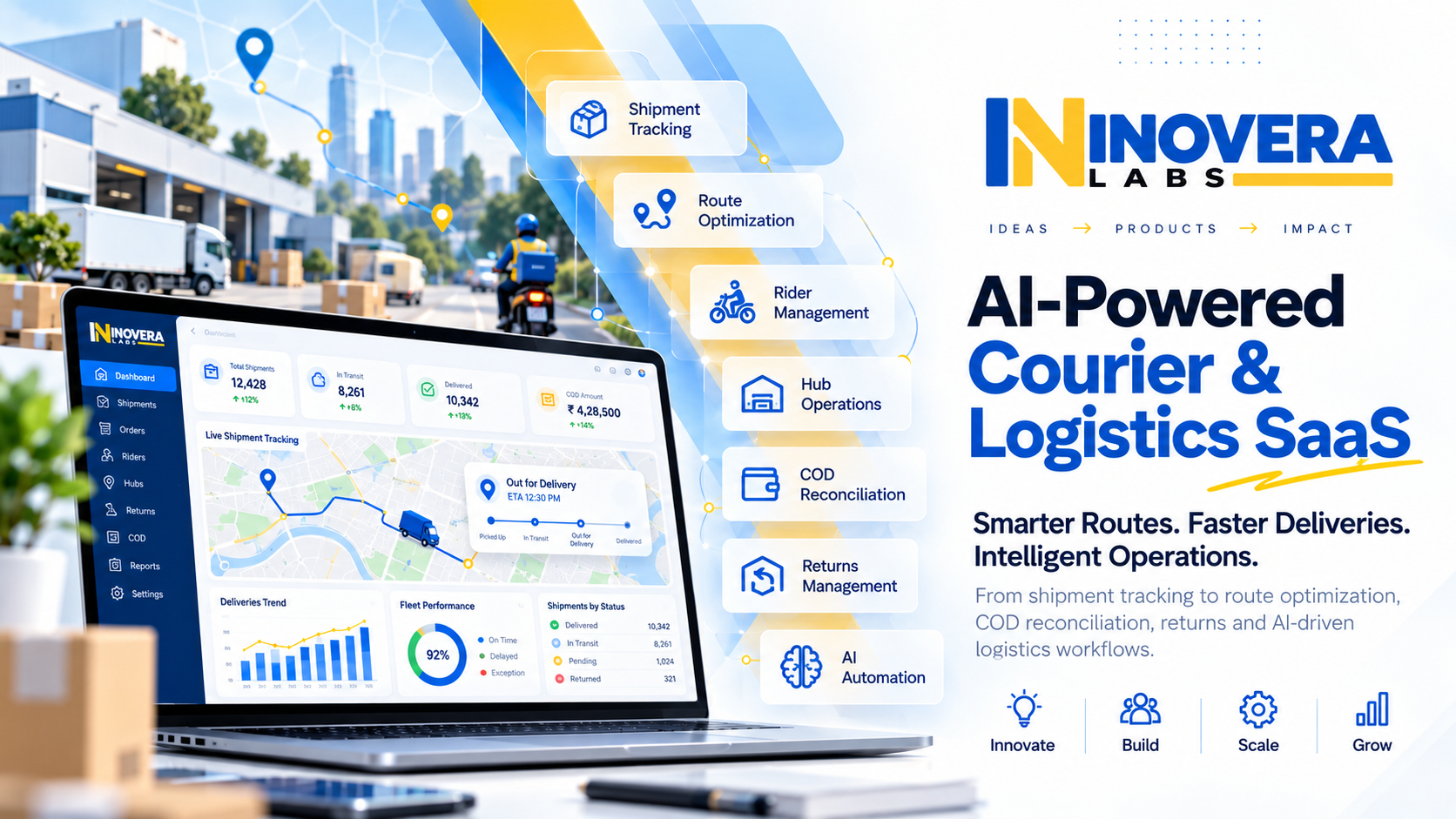
AI-Powered Courier & Logistics SaaS: Building Smarter Delivery Operations
Courier and logistics businesses are handling more deliveries, more customer expectations,
more payment reconciliation, and more operational complexity than ever before.
Yet many logistics companies still depend on disconnected spreadsheets, manual rider assignment,
phone calls, WhatsApp messages, separate accounting systems, and basic shipment-tracking software.
The problem is no longer simply:
“Where is my parcel?”
The bigger questions are:
- Which rider should receive the shipment?
- What is the most efficient delivery route?
- Which hub is becoming overloaded?
- Which deliveries are likely to fail?
- How much COD cash should each rider return?
- Which merchants have outstanding settlements?
- Where are operational delays happening?
- How can returns be processed faster?
- How many riders will be required tomorrow?
- Can AI automate repetitive logistics decisions?
This is where a modern
Courier & Logistics SaaS platform powered by AI
becomes valuable.
At Inovera Labs, we are designing logistics technology around the complete
operational lifecycle—from order creation and pickup to routing, hub processing, last-mile
delivery, COD reconciliation, returns, reporting, and intelligent automation.
What Is a Courier & Logistics SaaS Platform?
Courier and Logistics SaaS is a cloud-based system that centralizes delivery operations
into one platform.
Instead of maintaining separate applications for merchants, riders, administrators, hubs,
tracking, finance, and reporting, companies can operate through an integrated system.
A modern platform can support:
- Courier companies
- E-commerce businesses
- Marketplace sellers
- Retail chains
- Distribution companies
- Delivery fleets
- Field-service businesses
- Third-party logistics providers
- On-demand delivery companies
Because the software is delivered as SaaS, multiple businesses, branches, hubs, sellers,
or franchises can use the infrastructure while maintaining their own users, configurations,
permissions, shipments, and reports.
The Complete Shipment Lifecycle
A logistics platform should manage much more than shipment creation.
A typical workflow begins when a seller creates an order through the portal, mobile application,
bulk upload, or API integration.
The system generates a shipment and tracking reference.
The shipment is assigned to the appropriate pickup operation.
Once collected, it moves through its configured logistics network.
A shipment may pass through:
Seller → Pickup Rider → Origin Hub → Sorting →
Destination Hub → Delivery Rider → Customer
Every movement creates operational data.
The platform can record:
- Shipment status
- Rider
- Hub
- Scan event
- Location
- Timestamp
- Payment method
- Delivery attempt
- Customer response
- Proof of delivery
- Failure reason
- Return status
This creates a complete chain of custody and gives both operators and customers visibility
into the delivery process.
Intelligent Rider Assignment
Manual rider assignment becomes inefficient as shipment volume increases.
An intelligent dispatch engine can automatically evaluate available riders using factors such as:
- Rider location
- Delivery zone
- Current workload
- Vehicle type
- Shipment priority
- Package capacity
- Historical performance
- Delivery deadlines
- Distance from pickup point
Instead of simply assigning shipments to the nearest rider, the system can calculate the most
operationally efficient assignment.
This reduces unnecessary travel and helps balance workloads across the delivery fleet.
AI Route Optimization
Route optimization is one of the strongest applications of AI in logistics.
A rider may receive dozens of deliveries during a shift. Delivering them in the order they entered
the system can significantly increase travel time and fuel consumption.
An intelligent routing engine can analyze multiple factors, including:
- Delivery locations
- Distance
- Shipment priority
- Rider capacity
- Delivery windows
- Historical travel times
- Traffic patterns
- Failed-delivery probability
- Hub cut-off times
The platform can then generate an optimized delivery sequence.
Routes can also be recalculated when conditions change.
For example, if a high-priority shipment is added or a rider becomes unavailable,
the system can redistribute deliveries and generate updated routes.
The objective is not merely to find the shortest geographical route.
The objective is to find the most operationally efficient route.
Smarter Estimated Delivery Times
Customers increasingly expect accurate delivery estimates.
A basic system might calculate ETA using distance alone.
An AI-powered system can improve predictions by analyzing historical delivery information.
Possible variables include:
- Route
- Rider performance
- Area
- Time of day
- Day of week
- Shipment type
- Number of delivery stops
- Historical delays
- Hub processing time
As more delivery data becomes available, ETA predictions can become more accurate.
Instead of displaying a broad statement such as:
“Out for delivery.”
The platform can eventually provide more useful information, such as an estimated delivery window.
Real-Time Shipment Tracking
Tracking should provide transparency across the complete logistics network.
Customers can view shipment progress through a public tracking page,
while internal teams can access more detailed operational information.
Possible shipment statuses include:
- Order created
- Pickup scheduled
- Picked up
- Arrived at origin hub
- In sorting
- Dispatched to destination hub
- Arrived at destination hub
- Out for delivery
- Delivered
- Delivery failed
- Return initiated
- Returned to seller
For larger operations, tracking can also provide administrators with live maps showing
rider locations and active deliveries.
This helps support teams answer customer questions without repeatedly contacting riders.
Hub Operations and Sorting
Courier operations become significantly more complicated when multiple hubs are involved.
The platform should therefore provide dedicated hub-management capabilities.
Hub teams can process shipments through scanning workflows.
Example hub workflow
Inbound Scan → Sorting → Bagging → Dispatch →
Destination Hub → Delivery Assignment
Each scan creates an auditable event.
Operations teams can monitor:
- Shipments currently inside a hub
- Incoming shipments
- Outgoing shipments
- Pending sorting
- Delayed shipments
- Missing scans
- Destination distribution
- Hub processing performance
AI can also help identify unusual patterns.
If shipments normally remain inside a hub for two hours but a particular group has remained there
for eight hours, the system can automatically flag the situation for investigation.
Cash-on-Delivery Reconciliation
COD remains one of the most operationally difficult parts of courier management in many markets.
When a rider collects cash from customers, the platform must track exactly how much money is expected.
For example, a rider completes 30 deliveries and twenty shipments are COD orders.
The system automatically calculates:
Expected Rider Cash = Total COD Collected − Approved Adjustments
When the rider returns to the hub, the cashier or operations manager can record the deposited amount.
The system compares:
Expected Amount vs Deposited Amount
Any difference becomes a reconciliation discrepancy.
This creates a structured audit trail rather than relying on manual spreadsheets.
The same financial workflow can continue into merchant settlement.
The platform can calculate:
- Gross COD collected
- Delivery charges
- Return charges
- Service fees
- Adjustments
- Taxes
- Net merchant payable
This can significantly simplify seller settlements and financial reporting.
Returns and Reverse Logistics
A delivery platform is incomplete without a strong return-management workflow.
Shipments can fail because:
- Customer unavailable
- Incorrect address
- Customer refused shipment
- Phone unreachable
- Payment unavailable
- Address outside service area
The platform should record standardized failure reasons.
Business rules can then determine the next action.
A shipment might be:
- Reattempted
- Rescheduled
- Held at a hub
- Escalated to the seller
- Converted into a return shipment
Reverse logistics can then be tracked back through the network until the item reaches the merchant.
This gives sellers much better visibility into returned inventory.
AI-Based Delivery Failure Prediction
Historical shipment data can be used to identify deliveries with a higher likelihood of failure.
The system could evaluate factors such as:
- Destination
- Customer history
- Order value
- Previous delivery attempts
- Seller
- Shipment category
- Delivery timing
- Address quality
High-risk deliveries can then trigger preventive actions.
For example, the platform might request customer confirmation before dispatching the rider.
The objective is not to replace operations teams but to help them focus attention
where intervention is most useful.
Demand Forecasting
Courier companies frequently experience highly uneven shipment volumes.
Demand may increase because of:
- Weekends
- Promotional campaigns
- Salary dates
- Seasonal events
- Holidays
- Major e-commerce sales
AI-based forecasting can analyze previous shipment volume and estimate future demand by:
- City
- Zone
- Hub
- Merchant
- Day
- Time period
Operations managers can use these forecasts to plan rider availability,
vehicles, hub capacity, and delivery shifts.
Automated Customer Communication
Many customer-support requests are repetitive.
Examples include:
- Where is my parcel?
- When will my parcel arrive?
- Can I reschedule delivery?
- Why did delivery fail?
- Can I change the address?
A logistics platform can automate many of these interactions through:
- Email
- SMS
- WhatsApp integrations
- Push notifications
- AI chat assistants
An AI assistant connected to shipment data can provide contextual responses instead of
generic chatbot messages.
For example, rather than saying:
“Your order is being processed.”
It could respond:
“Your shipment has reached the Karachi destination hub and is scheduled for delivery
during the next delivery cycle.”
Human agents remain available for exceptions while automation handles routine questions.
Seller Portal
Merchants should have direct access to their logistics operations.
A seller dashboard can allow businesses to:
- Create shipments
- Import shipments in bulk
- Print labels
- Track deliveries
- View COD collections
- Download settlement reports
- Manage returns
- View delivery performance
- Access invoices
- Manage API credentials
Larger sellers can integrate directly with the courier platform through APIs or webhooks.
When an order is created inside their e-commerce system,
a courier shipment can automatically be generated.
Shipment updates can then synchronize back to the merchant's system.
Rider Mobile Application
Riders need a focused application designed for field operations.
Core functionality can include:
- Assigned pickups
- Assigned deliveries
- Optimized routes
- Navigation
- Customer contact
- Delivery confirmation
- Failure reasons
- Proof of delivery
- COD collection
- Shift status
- Earnings or performance information
The rider application can also provide location information to the dispatch platform
while the rider is active.
Field-Service Scheduling
The same logistics infrastructure can extend beyond parcel delivery.
Businesses that dispatch technicians, inspectors, installers, maintenance teams,
or service personnel face similar scheduling challenges.
The system can assign field jobs based on:
- Location
- Skill
- Availability
- Priority
- SLA
- Workload
This makes the platform useful beyond traditional courier operations.
Operational Intelligence
Collecting data is useful only when businesses can act on it.
Management dashboards can track metrics such as:
- Total shipments
- Successful delivery rate
- First-attempt delivery rate
- Average delivery time
- Failed deliveries
- Return rate
- COD outstanding
- Rider productivity
- Hub processing time
- Seller performance
- Delivery cost per shipment
AI can add another layer by identifying trends and anomalies.
Instead of requiring managers to search through reports manually,
the platform can surface observations such as:
“Delivery failures in Zone B increased 24% compared with the previous week.”
“Hub processing time has exceeded its normal range during the last three days.”
This turns logistics software from a record-keeping system into a decision-support platform.
Multi-Tenant SaaS Architecture
A modern logistics platform can operate as multi-tenant SaaS.
Each courier company can have its own:
- Organization
- Branches
- Hubs
- Sellers
- Riders
- Users
- Pricing rules
- Tracking configuration
- Reports
- Branding
A central SaaS operator can manage plans, subscriptions, platform configuration,
security, usage, and tenant administration.
This creates the foundation for offering logistics technology to multiple courier
and delivery businesses without maintaining separate software deployments.
APIs and Integrations
Logistics systems rarely operate independently.
A production platform should provide integrations for:
- E-commerce stores
- ERP systems
- Accounting systems
- Payment providers
- SMS platforms
- Email systems
- Mapping providers
- Mobile applications
- Marketplace platforms
Webhooks can notify external applications whenever a shipment changes status.
This makes the logistics platform part of a broader business technology ecosystem.
Why AI Matters in Logistics
Adding AI simply because it is popular does not create business value.
AI becomes useful when it reduces repetitive decisions, detects operational problems earlier,
improves resource utilization, or produces better predictions.
Some of the highest-value applications include:
- Intelligent rider assignment
- Route optimization
- ETA prediction
- Delivery failure prediction
- Demand forecasting
- Operational anomaly detection
- Automated customer support
- Capacity planning
- Intelligent reporting
The most effective model:
Automation handles repetitive decisions. AI assists with predictions.
Humans control exceptions and critical decisions.
The Future of Courier Operations
Logistics businesses are gradually moving from reactive operations toward predictive operations.
Traditional software tells managers:
What happened?
Modern analytics explains:
Why did it happen?
AI-powered logistics systems can increasingly answer:
What is likely to happen next, and what action should we consider?
That transition can improve customer experience, reduce operational costs, increase delivery
success rates, strengthen financial controls, and help logistics businesses scale without
proportionally increasing administrative overhead.
Building Logistics Technology with Inovera Labs
At Inovera Labs, we design and develop software platforms around
real operational workflows.
Our Courier & Logistics SaaS initiative combines shipment management, seller operations,
rider management, hub workflows, route optimization, COD reconciliation, returns, tracking,
field-service scheduling, reporting, APIs, and AI-driven automation within a unified architecture.
For courier companies and businesses still managing critical logistics processes through
spreadsheets, disconnected applications, and manual coordination, the opportunity is not
simply to digitize existing processes.
It is to redesign them around
automation, real-time data, and intelligent decision support.
Innovate. Build. Scale.